Why a Thermal Camera Can Mislead You About Blade Temperature
A thermal image looks persuasive. One blade glows orange, another looks blue, and the screen supplies a temperature to a decimal place. It is easy to treat that as a settled comparison.
With reflective metal, it may be a comparison of surfaces, surroundings and camera settings as much as a comparison of temperature. That distinction matters before you use the image to choose a blade—or tell a client that one material cannot get hot.
The camera does not see temperature directly
A thermal camera measures infrared radiation and uses assumptions to estimate surface temperature. Emissivity describes how effectively a surface emits thermal radiation. Reflective metals can be difficult targets, and measurement accuracy also depends on factors such as distance and the surrounding temperature. The camera manufacturer's documentation explains these limitations. Read the measurement guidance.
A default setting suited to a matte surface is not automatically right for every shiny, polished or coated component. Nor should two visibly different blade surfaces be assigned an identical value just because they are both sold as grooming blades.
Decide what you are trying to compare
“Which blade runs cooler?” is incomplete. Do you mean the stationary comb, the moving cutter, a particular point on the body of the blade, or the assembly after a defined period of work? Are you comparing the same cutting length and width? Is the drive system the same?
Write the question before collecting a reading. Otherwise, it is very easy to choose whichever part of the image supports the answer you expected.
For a workshop comparison, record at least:
- The exact blade assemblies, condition and maintenance history.
- The clipper and operating setting used.
- The same starting conditions and a clearly defined workload.
- The measurement location and method.
- The elapsed time between stopping the tool and taking the reading.
- Repeated results, including those that disagree.
This is a proposed comparison record, not a validated VUNRO test method. A fair test needs an appropriate instrument and someone who understands its limitations. A single picture cannot establish a general performance percentage.
Do not modify the cutting surface to make the picture easier
Thermography techniques used on industrial objects may involve surface treatments. Do not transfer those casually to a working grooming blade. Tape, paint or other material on teeth or moving parts can interfere with the assembly and does not belong in a grooming session.
If reliable measurement is needed, have a competent technician choose a suitable method for the stopped assembly. A contact probe has its own requirements: sensor placement, contact quality and response time still matter. “Contact” does not automatically mean “accurate”.
Keep measurement experiments away from the dog. They should never involve extending a grooming pass until an arbitrary temperature is reached.
Use the result for the decision it can support
A consistent difference under one controlled setup can help you decide what to investigate next. It does not establish that the difference will remain the same with another coat, a different drive, a worn cutter or altered maintenance.
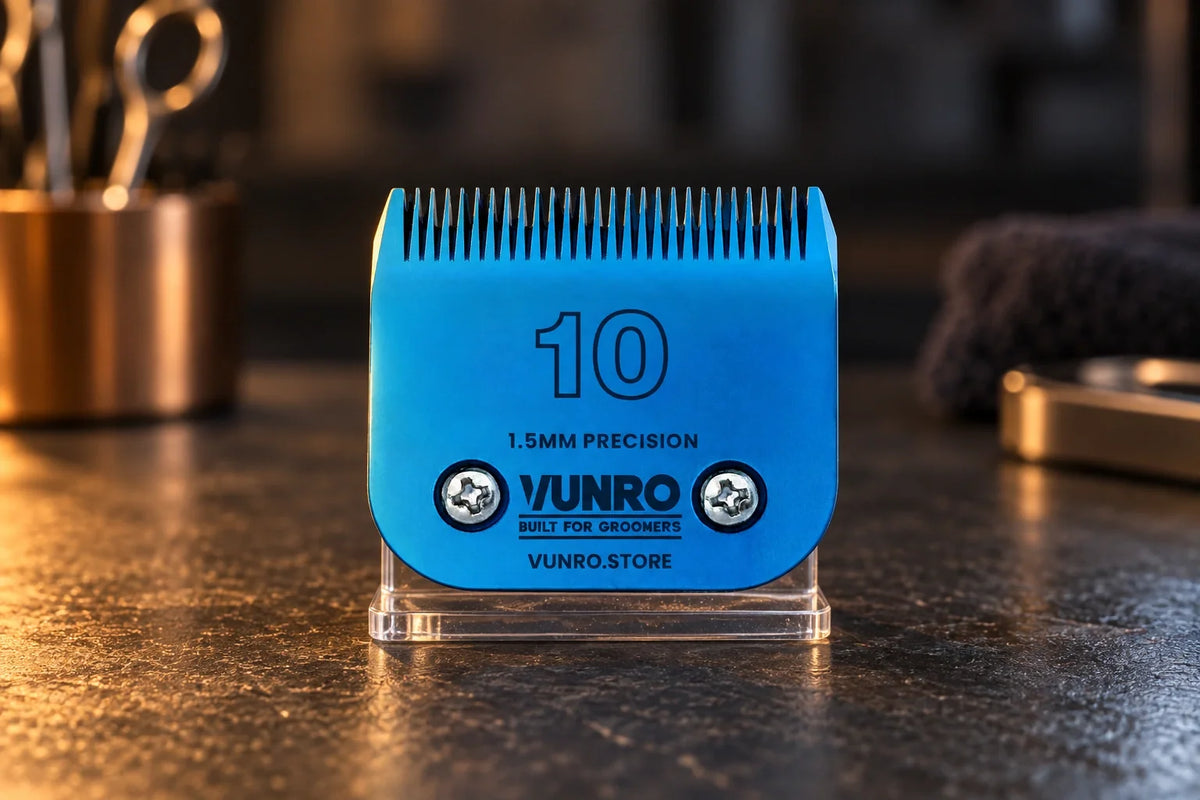
Likewise, visible colour is not a temperature rating. The blue appearance of the VUNRO #10 A5 blade in the photograph identifies its finish; it is not a heat map. The photograph is illustrative and contains no temperature measurement.
Make the working kit easier to manage
For everyday work, useful preparation includes having the appropriate lengths clean and ready, keeping maintenance current and having a suitable spare for repeated tasks. A second #10 blade may serve a different purpose from adding a #5F blade: one adds availability at an existing setting, the other adds a length option.
Choose according to your appointments and exact clipper system. A spare is useful when it supports a proper cleaning, inspection and cooling routine; it does not remove the need to check the tool during use. Do not assume that a blade is comfortable simply because a timer has not expired or a camera still displays a reassuring colour.
For the step that comes before any blade comparison on a dog, read the coat-preparation guide. Inconsistent preparation can turn a supposed tool comparison into two different grooming jobs.
Source and scope
FLIR Edge series documentation, Using a thermal camera. This source explains measurement limitations; it does not test VUNRO products or establish a safe blade-temperature threshold. The workshop record above is practical measurement planning, not a published performance claim.
Keep learning
More from the Blade Blog
Separate a Dry Surface from a Dry Coat
Read the guide →
Check the Outline in Motion Before Making Another Cut
Read the guide →